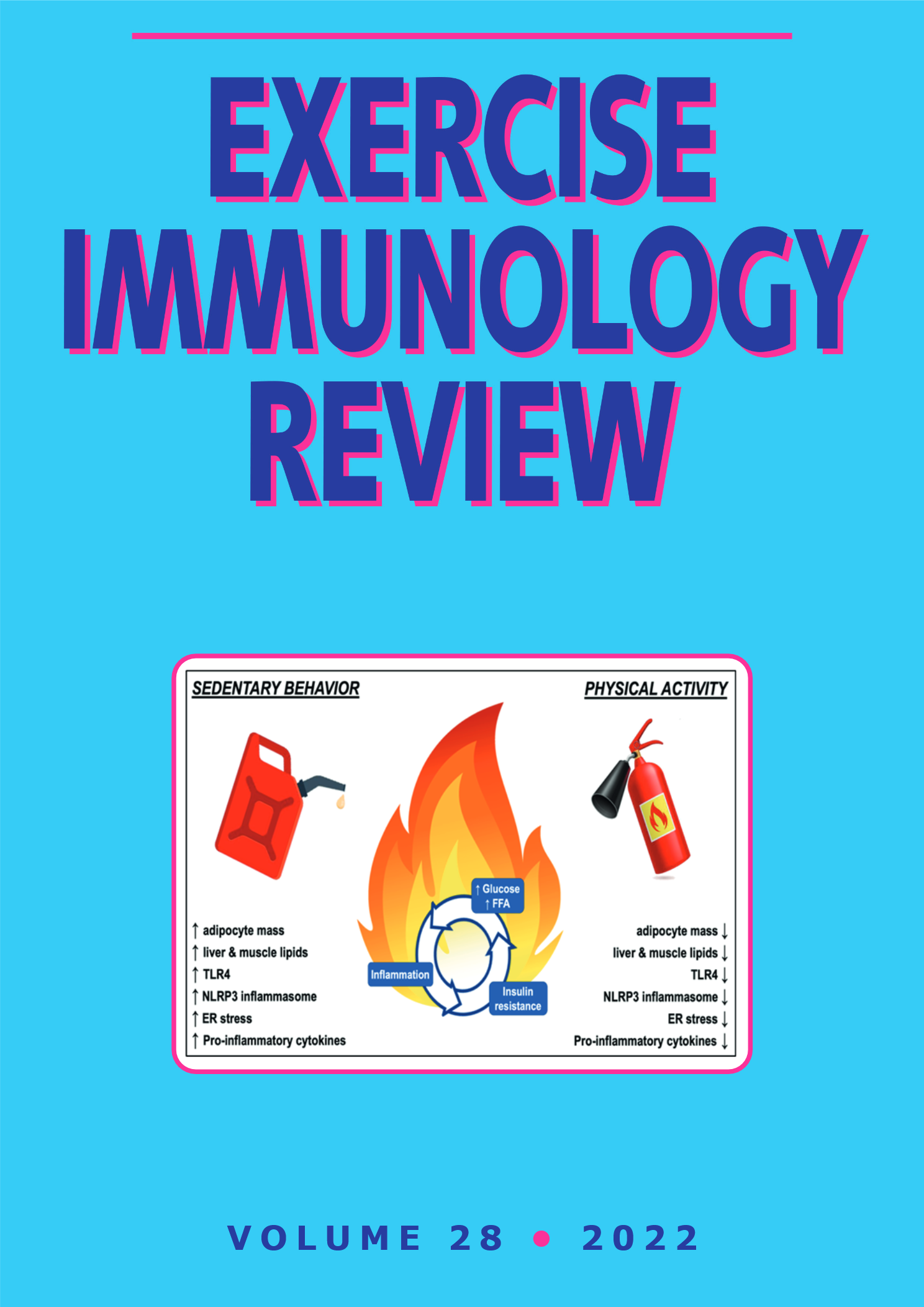
Immunometabolism-fit: How exercise and training can modify T cell and macro- phage metabolism in health and disease

Autor/innen

  • Benedicte Chazaud Univ Sao Paulo, Inst Biomed Sci, Dept Cell Biol & Dev, BR-05508000 Sao Paulo, SP, Brazil Autor/in
  • David B. Pyne Sao Paulo State Univ UNESP, Dept Phys Educ, Exercise & Immunometabolism Res Grp, BR-19060900 Presidente Prudente, Brazil Autor/in
  • Barbara Moura Antunes Univ Arizona, Sch Nutr Sci & Wellness, Dept Pediat, Dept Immunobiol, Tucson, AZ USA Autor/in
  • Graham Landells Univ British Columbia, Sch Hlth & Exercise Sci, Okanagan Campus, Kelowna, BC, Canada Autor/in
  • Hashim Islam Univ Arizona, Sch Nutr Sci & Wellness, Dept Pediat, Dept Immunobiol, Tucson, AZ USA Autor/in
  • Benedicte Chazaud Univ Lyon, Univ Claude Bernard Lyon 1, CNRS 5261, INSERM U1315,Inst NeuroMyoGene,Unite Physiopathol, Lyon, France Autor/in
  • DB Pyne Univ Coimbra, Fac Sports Sci & Phys Educ, Res Ctr Sports & Phys Act, Coimbra, Portugal Autor/in
  • AM Teixeira Justus Liebig Univ Giessen, Inst Sports Sci, Dept Exercise Physiol & Sports Therapy, D-35394 Giessen, Germany Autor/in
  • Helena Batatinha Univ Sao Paulo, Inst Biomed Sci, Dept Cell Biol & Dev, BR-05508000 Sao Paulo, SP, Brazil Autor/in
  • BM Antunes Univ Sao Paulo, Inst Biomed Sci, Dept Cell Biol & Dev, Ave Lineu Prestes 524 lab 435, BR-05508000 Sao Paulo, SP, Brazil Autor/in
  • LG Minuzzi Univ Sao Paulo, Inst Biomed Sci, Dept Cell Biol & Dev, Ave Lineu Prestes 524 lab 435, BR-05508000 Sao Paulo, SP, Brazil Autor/in
  • Jana Palmowksi Justus Liebig Univ Giessen, Inst Sports Sci, Dept Exercise Physiol & Sports Therapy, D-35394 Giessen, Germany Autor/in
  • RJ Simpson Univ Sao Paulo, Inst Biomed Sci, Dept Cell Biol & Dev, Ave Lineu Prestes 524 lab 435, BR-05508000 Sao Paulo, SP, Brazil Autor/in
  • K Krüger Univ Sao Paulo, Inst Biomed Sci, Dept Cell Biol & Dev, Ave Lineu Prestes 524 lab 435, BR-05508000 Sao Paulo, SP, Brazil Autor/in

DOI:

https://doi.org/10.22029/eir.2022.1748

Schlagwörter:

ENDOPLASMIC-RETICULUM STRESS, HYPOXIA-INDUCIBLE FACTORS, FREE FATTY-ACIDS, SKELETAL-MUSCLE, PHYSICAL-ACTIVITY, ADIPOSE-TISSUE, SITTING TIME, PPAR-GAMMA, INSULIN SENSITIVITY, SEDENTARY BEHAVIORS

Abstract

Background: The term immunometabolism describes cellular and molecular metabolic processes that control the immune system and the associated immune responses. Acute exercise and regular physical activity have a substantial influence on the metabolism and the immune system, so that both processes are closely associated and influence each other bidirectionally.Scope of review: We limit the review here to focus on metabolic phenotypes and metabolic plasticity of T cells and macrophages to describe the complex role of acute exercise stress and regular physical activity on these cell types. The metabolic and immunological consequences of the social problem of inactivity and how, conversely, an active lifestyle can break this vicious circle, are then described. Finally, these aspects are evaluated against the background of an aging society.Major conclusions: T cells and macrophages show high sensitivity to changes in their metabolic environment, which indirectly or directly affects their central functions. Physical activity and sedentary behaviour have an important influence on metabolic status, thereby modifying immune cell phenotypes and influencing immunological plasticity. A detailed understanding of the interactions between acute and chronic physical activity, sedentary behaviour, and the metabolic status of immune cells, can help to target the dysregulated immune system of people who live in a much too inactive society.

Literaturhinweise

Veröffentlicht

2026-07-15

Ausgabe

Rubrik

Articles